
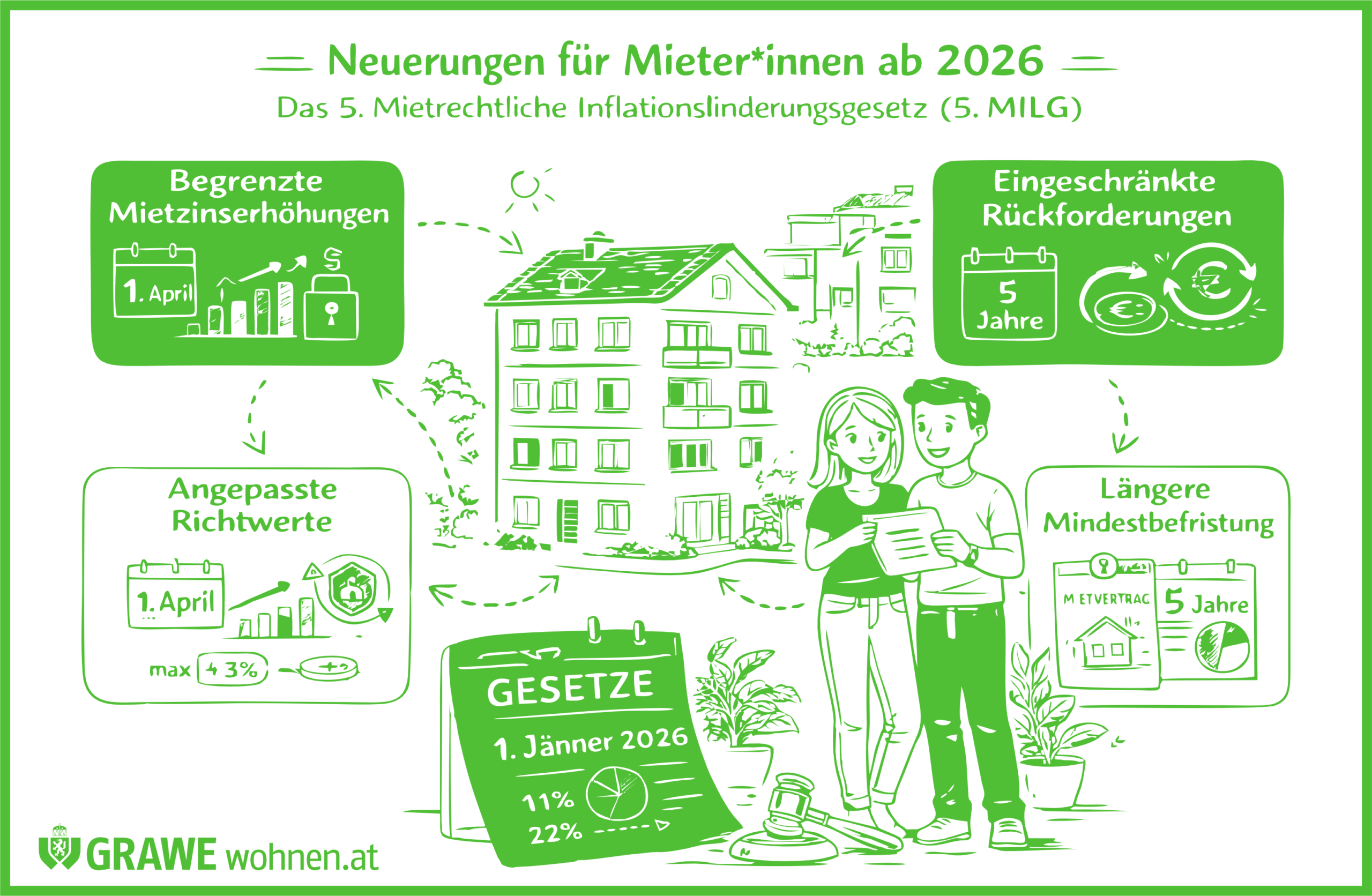
The 5th Rental Law Inflation Relief Act (5th MILG) at a Glance
On January 1, 2026, significant legal changes in rental law will come into effect. On December 11, 2025, the National Council passed the 5th Rental Law Inflation Relief Act (5th MILG). The aim of these new regulations is to protect tenants better in the face of high inflation and to create more predictability in rental costs. Most of the provisions also apply to existing rental agreements.
A key component of the legislative package is the new Rent Value Protection Act (MieWeG). Here is a summary of the most important points.
⇒ Limitation of Rent Increases through the MieWeG
In the future, the contractual value adjustment of apartment rental agreements under the full and partial application of the Tenancy Act (MRG) will be legally restricted:
Example:
If the average change in the CPI 2020 in the year 2028 is approximately 3.824%, then according to § 1 para. 2 item 1 sentence 3 of the MieWeG, the adjustment of the rent on April 1, 2029, is limited to 3 + (0.824/2)% = 3.412%.
Additional protective provisions apply in the price-regulated full application area of the MRG:
This effectively cushions sharp rent increases caused by inflation.
⇒ Limitation of Reimbursement Claims
Claims for the repayment of amounts from invalid value adjustment agreements will generally be limited to five years in the future. An exception applies if the invalidity is due to an abusive contractual clause as defined by the EU Directive on Unfair Terms.
⇒ Adjustment of Reference Values and Category Amounts
The legal adjustment of rental reference values and category amounts will also be aligned with the MieWeG system:
This establishes uniform and more predictable rules for rent adjustments in the future.
⇒ Longer Minimum Terms for Rental Agreements
Another significant change concerns fixed-term rental agreements:
These regulations apply under the full and partial application of the MRG, provided the landlord is an entrepreneur as defined by the Consumer Protection Act (KSchG). Exceptions exist for private landlords without entrepreneurial status.
Conclusion: An effort to create more protection and better planning reliability for tenants.
With the 5th MILG, the legislator is attempting to take a step toward curbing housing costs. Limited rent increases, new rules for value preservation, and “longer minimum fixed terms” are intended to provide greater stability, transparency, and security for tenants.
If you have any questions about the legal changes or your rental agreement, please do not hesitate to contact us – we are happy to assist you.


 Back
Back